ENERGY STAR
NRCan Proposes Decoupling ENERGY STAR Specs from its Energy Efficiency Regulations
by admin on Feb.19, 2013, under Canada, ENERGY STAR
Natural Resources Canada’s (NRCan) ENERGY STAR Initiative is considering significant changes in how products manufactured and/or sold in Canada are qualified and listed.
NRCan proposes to de-couple Canada’s ENERGY STAR technical specifications from its Energy Efficiency Regulations. NRCan intends to use the ENERGY STAR technical specification published by the United States Environmental Protection Agency (EPA) exclusively for ALL product categories (except fenestration products). A one month commentary period revealed that the harmonization of technical specifications with the EPA was not an issue for the majority of Canadian manufacturers.
This change, however, will result in other changes: using the EPA’s specification could result in manufacturers using test procedures which, at any given time, may not be identical to those used for Canada’s Energy Efficiency Regulations, for regulated products. As such, NRCan will not be collecting data from manufacturers’ EERs to auto-qualify their products for ENERGY STAR designation.
Analysis by NRCan reveals that this decision will only impact a small subset of manufacturers who sell regulated products in Canada only – and for the most part, only for those product categories whose ENERGY STAR specification’s test procedure differs significantly from the one required in Canada’s Energy Efficiency Regulations. These manufacturers may be required to pay for additional testing, in order to fulfill reporting obligations to both NRCan and the EPA.
Not changing: Canada’s Energy Efficiency Regulations stipulate that all prescribed energy-using products, imported or shipped inter-provincially for sale or lease in Canada, must bear an energy efficiency verification mark authorized by a certification body accredited by the Standards Council of Canada. (See MET’s energy efficiency verification mark here). The dealer of the energy-using product must ensure that an energy efficiency report is filed with NRCan for models available for sale or lease in Canada.
At the time that the ENERGY STAR Initiative was introduced into Canada in 2001, NRCan chose to set its own efficiency levels and testing procedures for some products subject to Canada’s Energy Efficiency Regulations, in order to harmonize them with those required for the Regulations. As such, ENERGY STAR qualification was automatically given to products which met the higher efficiency level required by the Canadian ENERGY STAR specification (harmonized with NRCan’s Regulations). Manufacturers wishing to designate products as ENERGY STAR qualified simply filled out voluntary fields in their EERs, and if their product met the specified level set by a database filter, they were listed as such.
Since that time, the number of product categories eligible for ENERGY STAR recognition has doubled, the frequency of technical specification updates or revisions has doubled, and NRCan has found that the efficiency levels of ENERGY STAR specifications in Canada and the United States are identical, regardless of the units of measure or the test procedures specified.
Products for sale or lease in Canada that are not subject to Energy Efficiency Regulations have always followed the EPA’s certification process in order to achieve ENERGY STAR qualification:
- Manufacturers must submit their product for testing to an EPA-approved laboratory
- Testing results must be validated by an EPA-approved Certification Body (CB)
- The CB must seek ENERGY STAR designation on behalf of manufacturers whose products they have validated as meeting the EPA’s specifications for ENERGY STAR qualification
- The product is recognized by the EPA and listed on their Web site
Moving forward, NRCan proposes that the above steps apply to all products which are currently eligible for ENERGY STAR designation in Canada, with the exception of fenestration products and HRVs. This means that EPA-recognized Certification Bodies must submit data to the EPA on behalf of their clients, for all products that manufacturers wish to be recognized as ENERGY STAR qualified. It also means that in order to do so, the data must come from an EPA-certified lab.
Comments and questions should be sent to NRCan’s ENERGY STAR Chief Dianna Miller at Dianna.Miller@nrcan-rncan.gc.ca. Include “ENERGY STAR Canada proposed changes” in your subject line.
MET Labs is an EPA-approved lab and certification body. Get a quote now.
Luminaires Manufacturers Get New ENERGY STAR Certification Resources
by admin on Jan.08, 2013, under ENERGY STAR
The U.S. Environmental Protection Agency (EPA) has posted new materials that aid in the testing and certification of lighting products for ENERGY STAR:
Certifying Luminaires – Utilizing the Certified Subcomponent Database (CSD)
This document helps luminaire manufacturers select components for ENERGY STAR fixtures. Items listed on the CSD have already been tested for photometric, life and/or electrical performance at EPA-recognized laboratories. Using the CSD can help reduce testing costs and time associated with the ENERGY STAR certification process for luminaires.
Certifying Luminaires – LED Light Engines and GU24 Base Lamps
This document helps explain the nuances and benefits of these two light sources and how to get these products listed on the CSD. Using these products in lieu of built-in LED systems can help reduce engineering and testing costs, and time to market. EPA’s latest ENERGY STAR specification for Luminaires provides a straightforward pathway for qualifying fixtures with these products.
Certifying Luminaires – Maximizing Testing Investment�
This document explains how testing costs can be minimized by utilizing allowable variations to group product together into a family. As an EPA-recognized certification body (CB), MET Laboratories can help determine the appropriate groupings.
Time to Certification
This document visually shows the process to qualify a luminaire and also provides estimates for lifetime testing.
More resources can be found on EPA’s ENERGY STAR lighting webpage and on its Frequently Asked Questions page.
For questions regarding testing and certification, contact MET Labs.
ENERGY STAR Partner Meeting Discusses New Requirements for Lighting & Consumer Electronics
by admin on Nov.12, 2012, under ENERGY STAR
The U.S. Environmental Protection Agency (EPA) ENERGY STAR Partner Meeting was a couple weeks ago in St. Paul, MN and MET Labs was there. Following is a summary of key meeting discussions.
New Requirement for Dimmable CFLs and LEDs
The meeting agenda began with a roundtable, which was focused on dimmers. EPA has encouraged consumers to transition to CFLs and LED bulbs to save energy, but their performance with dimmers has sometimes been less than optimal. Some dimmers are exhibiting flickering, noise and limited dimming. As a result, consumers are getting frustrated and switching back to incandescent bulbs.
The EPA is establishing a working group to introduce some basic requirements for all ENERGY STAR-labeled dimmable lamps/bulbs. It will include requirements for:
- Flickering
- Dimmer level
- Noise level
The test method is based on recommendations from NEMA and LRC (Lighting Research Center). The EPA is also considering a proposal to have building codes include dimmers for both CFLs and LED bulbs.
Lighting Certification Update
There are also updates on some new standards being developed for lighting certification, which are as follows:
- LM-84: To measure lumen and color maintenance of LED lamps, light engines and luminaires
- LM-85: To measure electric and photometric measurements for high power LEDs
- TM-26: To project rated life for LED packages
- TM-28: To project long term lumen maintenance of LED lights based on LM-84 data
Consumer Electronics Expansion
For consumer electronics, EPA intends to expand the product category in 2013 to include:
- Small Network Equipment
- Climate Control
- IP Phones
- Game Consoles
Specification Revisions
In 2013, there will be standard revisions for:
- Set-Top Boxes
- Battery Charging Systems
- Televisions
Touch and voice activation functionality will also be evaluated to implement as a function of energy for products with such features.
See other ENERGY STAR testing updates from MET Labs.
Utilize MET for Energy Efficiency testing and/or certification.
ENERGY STAR Most Efficient Program Made Permanent for 2013
by admin on Oct.09, 2012, under ENERGY STAR
The U.S. Environmental Protection Agency (EPA) has made the “Most Efficient” Program permanent for 2013. This ENERGY STAR program identifying the most efficient products has been in pilot mode since being introduced in 2011.
In 2012, more than 1,400 qualifying models from over 50 manufacturers in 8 product categories were recognized as ENERGY STAR Most Efficient.
In 2013, EPA and the U.S. Department of Energy (DOE) are proposing to add four new categories to the ENERGY STAR Most Efficient recognition program:
- Ventilating fans
- Ceiling fans
- Computer monitors
- Windows
Also for 2013, criteria for clothes washers and televisions are changed from 2012 in response to advances in the market. Further, EPA is proposing tailored requirements for ductless heating and cooling equipment recognizing different product applications than ducted products. For the remaining product types, 2012 recognition criteria have been maintained.
On September 27, EPA held a webinar to discuss the proposed 2013 recognition criteria. Stakeholder comments are due to mostefficient@energystar.gov by October 12. The 2013 criteria will be finalized by late October.
MET’s ENERGY STAR Program Manager will be at the 2012 ENERGY STAR Products Partner Meeting October 22–24, 2012 in St. Paul, Minnesota. Send an email to info@metlabs.com to schedule to meet with him.
Find out more about Energy Efficiency Product Testing.
ENERGY STAR Certification to Combine CFLs and LEDs into Lamp Specification
by admin on Aug.29, 2012, under ENERGY STAR
As mentioned previously, the Environmental Protection Agency (EPA) is combining the scope of the Compact Fluorescent Lamps (CFL) and Integral LED Lamps specifications into one technology-neutral Lamps specification.
EPA held a webinar on August 8, 2012 to describe some of the requirements of this Lamps Draft 2 specification. Following is a summary of some of the new electrical performance requirements. Please note that the following details are not finalized, but are provided for informative purposes to showcase draft details.
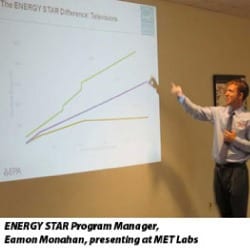
SIDE NOTE: EPA Program Manager for ENERGY STAR Eamon Monahan will be speaking at MET Labs’ Annual Global Product Compliance Seminar & Crab Feast in September. He will be providing an update on the ENERGY STAR Program. Register here.
Start Time
Starting time is defined as the time between application of power to the device and the point where the light output reaches 98% of its initial plateau.
Draft 2 of this specification adjusted the start time from 0.5 to 1 second. This was partially attributable to a conflict between decreasing the Start Time requirement while increasing the Rapid Cycle Stress Test requirement in Draft 1.
A start time test method was introduced in Annex D.
Run-Up Time
Run-Up time is defined as the time between the application of power to the device and the time when the light output first reaches a specified percentage of stable light output. This requirement is primarily based on the premise that the consumer expects quick response when using lamps.
Solid state products are now exempted from this requirement, while CFLs maintain the levels provided in Draft 1.
A run-up time test method was introduced in Annex E.
Power Factor
Draft 1 had listed a power factor of 0.7 for all lamps >5W. This has now changed as per lamp type. Draft 2 power factors are now:
- Residential CFLs ≥ 0.5
- Commercial CFLs ≥ 0.9
- Residential Solid State ≥ 0.7
- Commercial Solid State ≥ 0.9
Dimming
For the dimming requirement of the specification, the EPA is currently waiting on additional stakeholder input in the areas of:
- Dimming level
- Flicker
- Audible noise
- Compatibility
Transient Protection
Draft 2 made two changes to this requirement:
- There is now a new exemption for low voltage lamps
- Lamp base orientation language was removed from testing guidance
Electromagnetic & Radio Frequency Interference
Since FCC compliance is already required by law, reference to FCC requirements was removed from the specification.
Lamp Toxics Reduction
IEC 62554 was added as the test procedure reference for documenting the mercury content found in the product.
Lamp Base and Shape
A requirement for Lamp Base Dimensions and Tolerances was deleted from Draft 1. The requirement was considered redundant. Lamp base dimensions are already verified during electrical safety evaluation.
Lamp Shape Dimensional Requirements are now applicable to ANSI standard lamps only.
This new lighting specification and much more are sure to be discussed at the 2012 ENERGY STAR Products Partner Meeting for Lighting, Appliances, Water Heaters & Electronics being held from October 22–24, 2012 in St. Paul, Minnesota.
Find out how to get ENERGY STAR testing or certification body services or product safety certification for lighting.
ENERGY STAR Merges Lighting Scopes into New Luminaires & Lamps Specifications
by admin on Apr.19, 2012, under ENERGY STAR
Although this year marks the 20th anniversary of the ENERGY STAR program, lighting was a bit late to the party. It wasn’t until 15 years ago that residential light fixtures got their first ENERGY STAR specification, and 13 years ago that compact fluorescent light bulbs (CFLs) did.
ENERGY STAR lighting continues to evolve. Following are some updates.
Luminaires
The Luminaires Version 1.1 specification became effective April 1, 2012. It combines the scope of the Solid-State Lighting (SSL) Version 1.3 specification and the Residential Light Fixtures Version 4.2 specification.
Only those light fixture models that have been third-party certified as meeting the Luminaires V1.1 requirements now appear on the ENERGY STAR qualified product list. Fixtures qualified under the previous specifications will not be “grandfathered in” to this new specification.
There are nearly 500 qualified luminaires from more than 50 manufacturers, covering over 20 different product types.
Lamps
The new ENERGY STAR Lamps V1.0 specification is still being developed. This new specification will merge the scope of the Compact Fluorescent Lamps V4.3 and Integral LED Lamps V1.4 specifications into one technology-neutral specification.
For draft 1 of the Lamps specification, EPA received 175 pages of comments. These comments are being considered for draft 2, which is anticipated in the next several months.
Certification Bodies
Using the new third party certification (3PC) process, in 2011 Certification Bodies like MET Labs certified 191 CFLs, 357 LED lamps, 166 luminaires, and 1,462 light strings. In 2012, the number of lighting products certified is expected to be even higher.
According to EPA research, CB processing time ranges from 24 hours to two weeks, depending on a certification body’s work load and the completeness of a product submission.
Once a CB certifies a product meets an ENERGY STAR specification, it sends the data to EPA to be uploaded to the qualified products lists (QPLs). Lists are currently updated weekly for bulbs and twice a month for fixtures (around the first and the middle of the month). By the end of 2012, all product lists should be updated on a daily basis.
Upcoming Events
The next ENERGY STAR products partner meeting is October 22–24, 2012 in St. Paul, Minnesota. This is for lighting, as well as appliance and electronics partners and other stakeholders.
EPA Program Manager for ENERGY STAR Eamon Monahan will be speaking at MET Labs’ Annual Global Product Compliance Seminar & Crab Feast in September.
Find out how to get ENERGY STAR testing or certification body services.
E3 Energy Program and IEC 62368-1 Discussed by IECEE U.S. Committee
by admin on Mar.08, 2012, under ENERGY STAR, Product Safety
MET Labs participated in a meeting this week of the United States National Committee of the IECEE to discuss a number of issues.
E3 Program
There was much discussion about the E3 Program (Energy Efficiency, Energy Performance & Energy Consumption), covered in Compliance Today previously.
The U.S. initially opposed the E3 Program because there is a lack of harmonization. As it stands, there is no assured reciprocity and there is no certificate issued, just a Statement of Test Results (STR). It is up to the reader of the STR to decide to accept or not.
IEC 62368-1
UL and CSA have recently published harmonized versions of IEC 62368-1. It will, however, likely be a long time before this becomes a NRTL standard due to OSHA’s workload and their likely objection to its inclusion of hazard-based analysis. Major labs will list to it, but if a product is going into the workplace, then 60950 or 60065 must still be used.
Only the U.S., Sweden and Denmark have adopted 62368-1 in the Scheme per the CB website. Canada is to participate soon, as is France. The Netherlands may participate soon.
More about IEC 62368-1 is found in this Compliance Today post.
China EMC
China is not currently accepting EMC within the Scheme. China’s objection may be that this was once voluntary and that the Scheme adopted EMC as mandatory and have not given China time to revise its standards.
Motors
At least one manufacturer thinks there is a need for motors to be in the safety CB Scheme. The only place a motor standard is covered is within the EMC Scheme. NEMA’s 1MG Section is continuing its conversation regarding the inclusion of electric motors as part of the E3 Program.
Next meetings are May 22-23, 2012 in Vancouver, Canada, and August 7-8, 2012 in Orange County, California.
See a list of participating CB Scheme countries, and get a quote for CB Scheme testing.
EPA Announces Final Criteria for ENERGY STAR Most Efficient
by admin on Jan.31, 2012, under ENERGY STAR
The U.S. Environmental Protection Agency (EPA) recently announced the final 2012 recognition criteria for its ENERGY STAR “Most Efficient” designation, which recognizes products with exceptional efficiency performance.
In the second year of this pilot effort, eight product categories will be eligible for recognition:
- Air-source heat pumps
- Boilers
- Central air conditioners
- Clothes washers
- Furnaces
- Geothermal heat pumps
- Refrigerator-freezers
- Televisions
The Most Efficient designation may be used in retail displays or web pages, but not on products or product packaging. See the full usage guidelines.
The 2012 recognition criteria for ENERGY STAR’s Most Efficient are summarized here.
In addition to meeting these performance requirements, products must be certified as ENERGY STAR by an EPA-recognized certification body, like MET Labs.
Find out more about requirements, cost, and lead time for ENERGY STAR testing and certification.
Energy Efficiency Testing for Products Becoming More Widespread
by admin on Nov.28, 2011, under ENERGY STAR
The fastest growing sector of the electrical and electronic product test business is energy efficiency testing. This is no surprise, what with the ongoing depletion of known supplies of fossil fuels and its associated geo-political and cost implications, combined with the pollution and attendant climate change associated with energy consumption.
Here is an overview of some of the top product energy efficiency programs in major markets:
United States
In the U.S., ENERGY STAR – a voluntary program – is king. As covered here before, effective December 31, 2010, all ENERGY STAR products were required to be certified by an EPA-recognized certification body, like MET Laboratories. Today, there are more than 60 ENERGY STAR product categories, with 6 more in development.
In May 2011, U.S. EPA debuted the Most Efficient of ENERGY STAR pilot program. Today, there are more than 150 models from 16 manufacturers recognized as Most Efficient. MET Labs learned at the ENERGY STAR Partner Meeting in Charlotte earlier this month that EPA is extending the Most Efficient pilot through 2012 with limited changes.
Canada
In Canada, Natural Resources Canada (NRCan) maintains the Energy Efficiency Regulations and Standards for Industry. There are over 30 products regulated for energy efficiency in Canada.
Canada also participates in ENERGY STAR.
Europe
The EU utilizes three labeling schemes: Energy Labels, Ecolabels, and Ecodesign.
Energy labels are mandatory for all appliances placed on the EU market, and are specified in energy labelling Directive 2010/30/EU. Energy labels display ranking of products according to their energy efficiency consumption on an A to G scale. Once the majority of products reach class A, up to three classes (A+/A++/A+++) are added on top of class A.
Ecolabels are voluntary labels adopted by the European Commission on a product-by-product basis, and are specified in Ecolabel Regulation EC/66/2010. The Ecolabel, i.e. the flower logo, may be displayed if the product is among the most environmentally friendly in its sector.
Ecodesign requirements are applied on a product-by-product basis, and are specified in Ecodesign Directive EC/2009/125. Ecodesign requirements are mandatory and must be met by all products placed on the EU market. They are based on an assessment of the impact of the product on the environment throughout its life-cycle, starting from the production stage, through to distribution and disposal.
Europe also participates in ENERGY STAR.
CB Scheme
During IECEE assessor training in Toronto earlier this month, two MET Labs CB Scheme assessors learned more details about IECEE’s new Energy Efficiency, Energy Performance and Energy Consumption Program (dubbed E3 Program).
The IECEE Secretariat is now receiving applications from qualified labs for scope extension to operate in the IECEE E3 Program.
Certification within the E3 Program will provide a test report issued by a IECEE CBTL (Certification Body Testing Laboratory) and validated by a STR (Statement of Test Result) issued by an IECEE NCB (National Certification Body). The service can be used as a stand-alone service or as a combined safety and energy efficiency/performance service, upon request from the manufacturer, where both Test Reports are attached to the CB Test Certificate or the FCS (Full Certification Scheme) Certificate issued by the IECEE NCB.
ENERGY STAR Undergoes Specification Updates for Televisions, Computers, Displays & Imaging Equipment
by admin on Sep.14, 2011, under ENERGY STAR
The U.S. Environmental Protection Agency (EPA) is in the midst of updating many ENERGY STAR specifications. Here is the status of a few key categories:
Televisions
The effective date of Version 5.3 ENERGY STAR Program Requirements for Televisions is September 30, 2011. Version 5.3 was finalized on January 24, 2011. These requirements establish challenging On Mode power consumption levels, take steps to ensure a TV is viewed in the mode in which it qualified for ENERGY STAR, and curb energy associated with downloading program guide data.
In light of efforts to develop a test method for televisions that implement Automatic Brightness Control (ABC), an energy-savings feature, EPA delayed the release of the Draft 2 Version 6.0 Televisions specification until Fall 2011, with the aim of finalizing the specification by the end of 2011 and having it take effect in Fall 2012.
For ABC, EPA is factoring into the test method the findings from the Consumer Electronic Association’s study of average room illuminance levels in consumer homes. Additionally, EPA is harmonizing its ENERGY STAR television testing requirements with those under development by the U.S. Department of Energy (DOE).
Computers
The current ENERGY STAR requirement for computers is Version 5.2.
The ENERGY STAR specification for computers is currently under revision. EPA is kicking off the dataset assembly effort for development of the ENERGY STAR Version 6.0 Computer Specification. For consideration, data must be forwarded to computers@energystar.gov using the appropriate form by Wednesday, September 14, 2011.
Displays
The current ENERGY STAR requirement for displays is Version 5.1.
The ENERGY STAR displays product specification is currently under revision. EPA hosted a webinar on June 22, 2011 to discuss proposed changes to the test method and receive comments on applying IEC 62087 to test all display products. Incorporating stakeholder feedback, EPA released a revised test method, and accompanying documents, for Draft 1 of the Version 6.0 ENERGY STAR Display Product Specification.
EPA is now considering all test data and comments on the proposed edits in the Draft 1 specification and test method in its analysis for Draft 2. EPA will also propose performance levels for all product types/sizes in Draft 2.
Imaging Equipment
The current ENERGY STAR requirement for imaging equipment is Version 1.1.
The ENERGY STAR specification for imaging equipment is currently under revision. The revised test method is Version 2.0.
There are many other revisions to existing specifications as well as new product specifications in development.
More about ENERGY STAR testing and certification.