
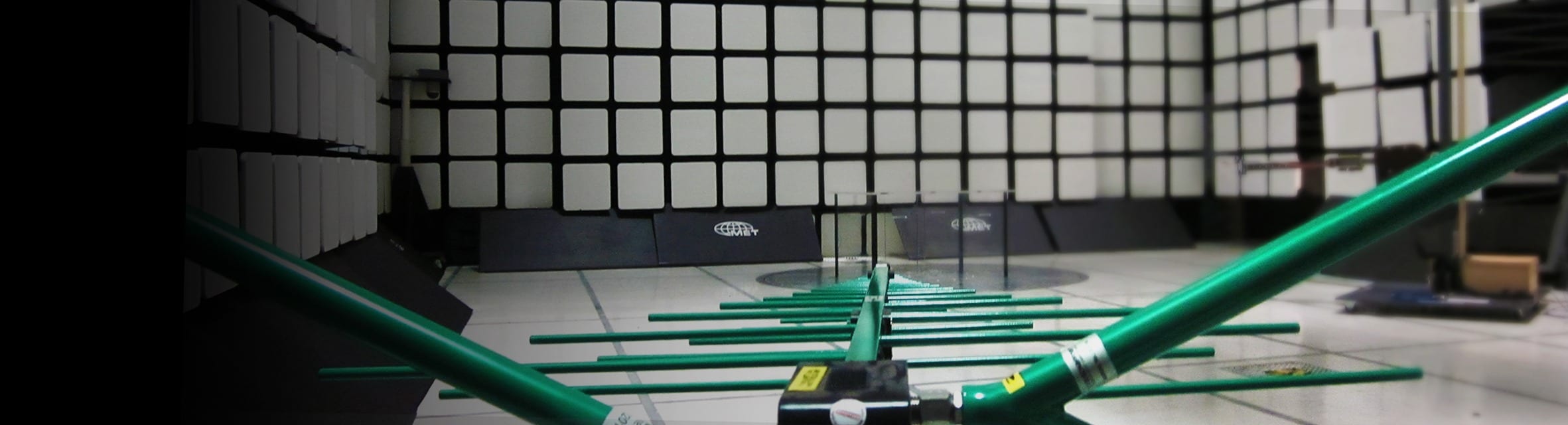
We have the facilities, accreditations, and experience to accurately and efficiently perform testing to a wide range of military and aerospace specifications, including the latest indirect lightning tests.
How are we uniquely qualified to meet your airborne equipment testing requirements?
- Full-service laboratories in Maryland and California
- Secure facilities
- Highly-trained personnel
- One-stop-shop for EMC & Environmental Simulation requirements
- Reverberation Chamber for HIRF over 20,000 V/m
- 45kVA fully programmable power supply with Section 16 Power Input plus Boeing and Airbus specific test software. DC through over 1000Hz output frequency. 1/3-phase output
- 20kVA variable power supply, 400Hz, 1/3-phase output
- Three RF anechoic EMC chambers with 1/3-phase 400Hz RF power filters with Power Factor Correction Coils (PFCCs) and RF filtered DC power
- Up to 150VAC line to ground, 3-phase, 400Hz, 100A per phase, RF filtered power
- Up to 277VAC line to ground, 3-phase, 400Hz, 50A per phase, RF filtered power
- Acceleration Testing Capabilities up to 40 Gs
We are A2LA-accredited to perform RTCA/DO-160 Commercial Aircraft Product testing to RTCA/DO-160D (1997), RTCA/DO-160E (2005), RTCA/DO-160F (2007), and RTCA/DO-160G (2010).
A2LA
- 0591.01
- 0591.02
- 0591.04
RTCA/DO-160 Environmental Conditions and Test Procedures for Airborne Equipment
- Section 4 – Temperature and Altitude
- Section 5 – Temperature Variation
- Section 6 – Humidity
- Section 7 – Operational Shocks and Crash Safety
- Section 8 – Vibration
- Section 9 – Explosion Proofness
- Section 10 – Water Proofness
- Section 11 – Fluids Susceptibility
- Section 12 – Sand and Dust
- Section 13 – Fungus Resistance
- Section 14 – Salt Spray
- Section 15 – Magnetic Effect
- Section 16 – Power Input
- Section 17 – Voltage Spike
- Section 18 – Audio Frequency Conducted Susceptibility – Power Inputs
- Section 19 – Induced Signal Susceptibility
- Section 20 – Radio Frequency Susceptibility (Radiated and Conducted)
- Section 21 – Emission of Radio Frequency Energy
- Section 22 – Lightning Induced Transient Susceptibility
- Section 24 – Icing
- Section 25 – Electrostatic Discharge (ESD)
We also test to proprietary aircraft manufacturer standards:
- Airbus: ABD0100.1.2 Environmental Conditions and Tests Requirements Associated to Qualification
- Airbus: ABD0100.1.8.1 Electrical and Installation Requirements
- Boeing: 787B3-0147 Electrical Power Quality and Design Requirements Document
- Boeing: D6-16050-5 Requirements for Electromagnetic Interference Control