
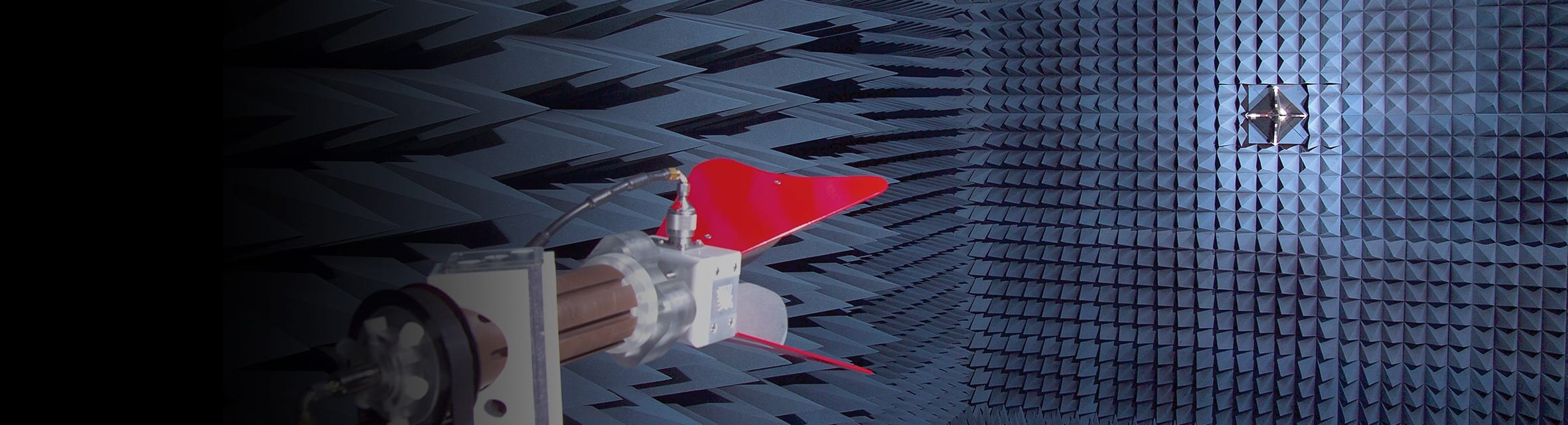
We have the accreditation’s and experience to efficiently and cost-effectively perform Specific Absorption Rate (SAR) Testing up to 6GHz for the United States, Canada & Europe
Our SAR facility is fully equipped with a Schmid & Partner Engineering AG (SPEAG™) DASY professional system utilizing an RX 90 robotic arm for extended reaching capabilities. In addition, our DASY system has multiple twin SAM phantoms and planar phantoms which allows for quick testing turnaround times. The DASY is capable of evaluating products for SAR to all the global SAR standards for both head and body-worn devices.
We test an array of products such as Cellular/PCS GSM/DCS CDMA/GMSK/TDMA/AMPS phones, PDAs, Laptops, held-to-face devices, W-LAN (2.4GHz and 5GHz), and so on.
In conjunction with SAR testing, we also perform Maximum Permissible Exposure (MPE) evaluations for fixed and/or mobile applications. These evaluations are performed on radiating structures that would be intended to be used at distances >20cm from the end-user. Typical devices we test are vehicle-mounted antennas operating in the UHF and VHF bands.
SAR Testing Standards we test to:
- IEEE STD 1528 IEEE – Recommended Practice for the Measurement and Computations with respect to Human Exposure to Radio Frequency Electromagnetic Fields, 100kHz to 300GHz.
- FCC OET 65 – Supplement C Evaluating Compliance with FCC Guidelines for Human Exposure to Radio Frequency Electrometric Fields.
- IC RSS-102 – Radio Frequency RF Exposure Compliance of Radio communication Apparatus (All Frequency Bands)
- EN 50361 – Basic Standard for the measurement of Specific Absorption Rate related to human exposure to Electromagnetic Fields from Mobile Phones (300MHz – 3GHz)
- EN 62311 – Assessment of electron and electrical equipment related to human exposure restrictions for Electromagnetic fields (0Hz- 300GHz)
- IEC 62209-1 – Human exposure to radio frequency fields from hand-held and body-mounted wireless communication devices – Human models, instrumentation and procedures. Part 1: Procedure to determine the Specific Absorption Rate (SAR) for hand-held devices used in close proximity to the ear (frequency range 300MHz- 3GHz)
- EN 62209-2 – Human exposure to radio frequency fields from hand-held and body mounted wireless communication devices – Part 2: Procedure to determine the Specific Absorption Rate (SAR) for wireless communication devices used in close proximity to the human body (30MHz – 6GHz)
- ACMA – Radio communications (Electromagnetic Radiation – Human Exposure) Standard 2003
- ARIB STD-56 – Specific Absorption Rate (SAR) estimation for cellular phones (Japan, ARIB, Association of radio industries and businesses)
- EN 50360 – Demonstrates the compliance of cellular phones with the basic restrictions related to human exposure to electromagnetic fields (300 MHz – 3 GHz)
- EN 50364 – Limitation of human exposure to electromagnetic fields from devices operating in the frequency range 0 Hz to 10 GHz, used in Electronic Article Surveillance (EAS), Radio Frequency Identification (RFID) and similar applications
- EN 50371 – Generic standard to demonstrate the compliance of low power electronic and electrical apparatus with the basic restrictions related to human exposure to electromagnetic fields (10 MHz – 300 GHz) – General public
- EN 50385 – Product standard to demonstrate the compliance of radio base stations and fixed terminal stations for wireless telecommunication systems with the basic restrictions or the reference levels related to human exposure to radio frequency electromagnetic fields (110 MHz – 40 GHz) – General publicAs a Designated R&TTE CAB, which is a Notified Body, MET is authorized to review compliance in accordance with these standards as well as any other appropriate standards.
What is SAR testing?
These levels are expressed as watts per kilogram (W/kg). International regulatory bodies are requiring SAR evaluations for most portable and mobile wireless technologies.
Parameters that can affect SAR include:
- Types of radio service (cellular, PCS, LMR, WLAN, etc.)
- Types of modulations (CDMA, GMSK, TDMA, AMPS, etc.)
- Physical orientation to person (held-to-ear, held-to-face, belt-clip, lap-held, etc.)
- RF power level (in Watts or mW)
- Changes to transmitter, antenna (extracted/retracted) or accessories (clips, batteries, etc.)
The FCC classifies a wide range of standalone independently-operated portable transmitters as being potential candidates for SAR testing. Laptop computers, for example, may require SAR testing. Handsets, pagers, and other devices that are worn on a belt can also require SAR testing. When portable transmitter antennas and radiating structures are less than 20 cm from persons, except extremities (hands, wrist, feet and ankles), and depending on the device’s frequency and threshold levels, SAR testing may be required.